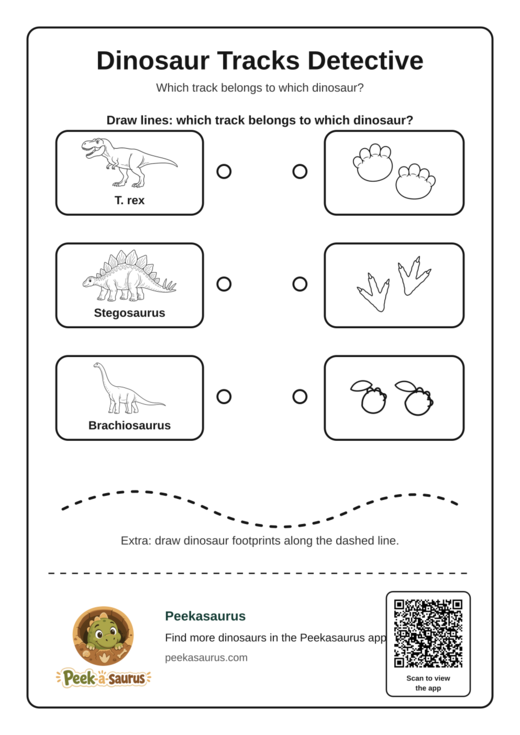
In Dinosaur Tracks Detective, children compare several footprints and connect each one to the matching animal. The activity combines careful observation, matching, and a small introduction to paleontology.
Printer, paper, and a pencil; optional toy dinosaurs and modeling dough
Ideas for this printable
1
Study each track
Count toes, compare wide and narrow shapes, and notice whether an animal walks on two legs or four.
2
Make a prediction
Ask the child to explain which track might fit before drawing the connecting lines.
3
Make your own tracks
Press toy dinosaur feet into dough or clay and compare the new impressions with one another.
What children practise
Children practise noticing visual differences, comparing features, and giving a reason for a choice. Drawing the connecting lines supports hand-eye coordination. The useful question is not only “Is it right?” but also “What helped you decide?”
A dinosaur fact to share
Fossilized footprints are trace fossils. They may reveal how an animal moved, which direction it travelled, or whether several animals used the same place. A single print often cannot identify one exact dinosaur species with certainty.
Good to know
Frequently asked questions
Does my child need to know the dinosaur names?
No. The visible shapes of feet and bodies provide the clues. An adult can read the names together with the child afterwards.
Do real dinosaur tracks always have one clear answer?
No. Scientists compare shape, size, rock, and nearby evidence. A track may identify a broader animal group rather than one precise species.