What children practise
Children separate observation from interpretation: first describe, then suggest an explanation. They sort features and learn that scientists draw conclusions from small clues while still acknowledging uncertainty.

Fossil lab
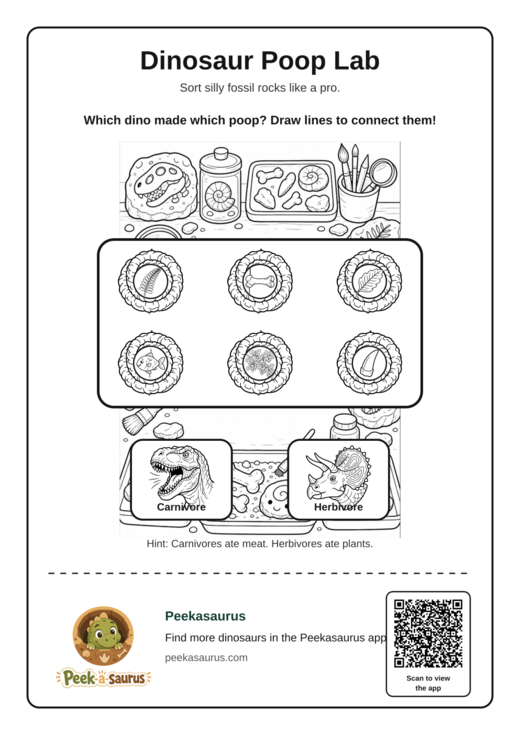
Dinosaur Poop Lab uses a subject many children immediately find funny to introduce genuine fossil questions. On the sorting page, they investigate possible coprolites and consider which food remains might be preserved inside.
Ready to play
Some activities also include a short guide with background information for grown-ups.
At a glance
Printer, paper, pencils, and optionally a collection of oddly shaped stones
Ideas for this printable
Notice pictured bone, plant, or other remains and begin by describing only what can actually be seen.
Decide which clues might fit a meat eater, plant eater, or animal with a more varied diet.
Give each discovery a number, sketch it, and write down one careful idea together.
What children practise
Children separate observation from interpretation: first describe, then suggest an explanation. They sort features and learn that scientists draw conclusions from small clues while still acknowledging uncertainty.
A dinosaur fact to share
Fossilized animal droppings are called coprolites. They may contain pieces of bone, plants, or other food remains. A coprolite cannot automatically be assigned to a dinosaur; its location, age, and surrounding evidence must also fit.
Good to know
The page treats fossils with humor but without unpleasant images. Many children find the unusual research subject especially engaging.
Not always. Contents, size, rock layer, and location provide evidence, but they do not necessarily point to one certain species.