What children practise
A simple maze supports early route choices, visual tracking, and controlled line movements. Children also experience that a wrong turn is not failure; it is useful information that helps them try a different path.

Maze
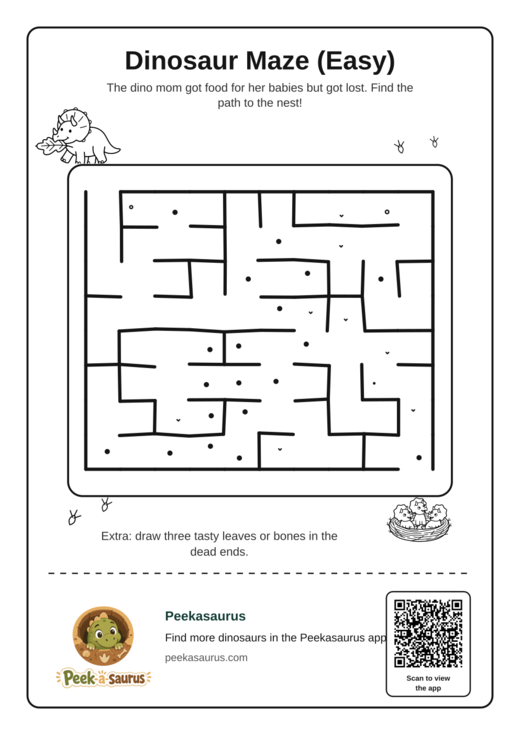
This easy dinosaur maze is designed for a child’s first puzzle attempts. Wide paths and a small number of decisions help younger children guide the dinosaur mother back to her nest without unnecessary frustration.
Ready to play
Some activities also include a short guide with background information for grown-ups.
At a glance
Printer, paper, a thick crayon, and optionally a small toy figure
Ideas for this printable
Trace the route without a pencil first. The child can explore and simply move back after reaching a dead end.
Once the path is familiar, follow it to the nest with a thick colored pencil or crayon.
Decide what food the dinosaur mother is carrying and how her babies welcome her home.
What children practise
A simple maze supports early route choices, visual tracking, and controlled line movements. Children also experience that a wrong turn is not failure; it is useful information that helps them try a different path.
A dinosaur fact to share
All known dinosaurs laid eggs. Fossil nests show that eggs were often placed in groups. Evidence from some dinosaurs suggests that adults remained near the nest or cared for young animals for a period after hatching.
Good to know
Guide a finger or small toy through the paths together. Add the pencil only after the route begins to make sense.
Of course. At this age, exploring and following a route matter more than keeping every line perfectly neat.